Science » Vegetation
Nisqually Post-Restoration Plant Summary:
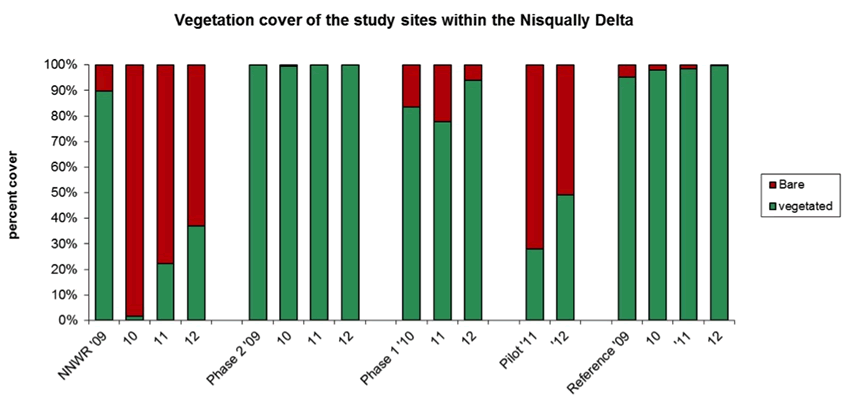
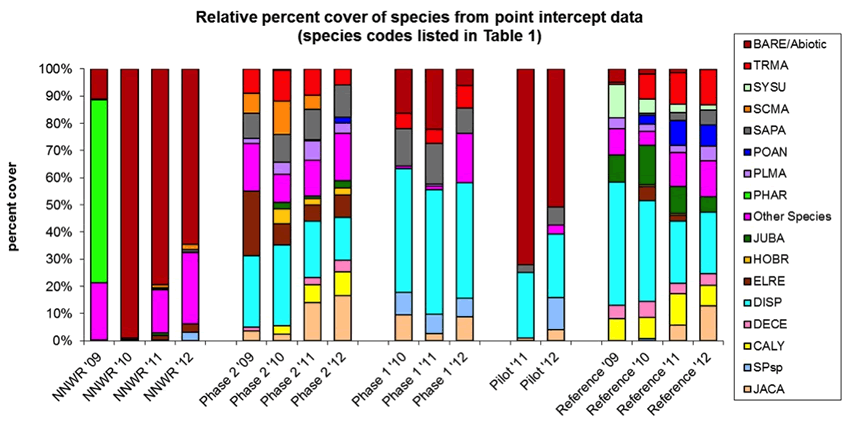
The following figures and tables are based on our summer 2009 pre-restoration survey of the Nisqually National Wildlife Refuge restoration site prior to dike removal.
(point intercept and quadrant) surveys.
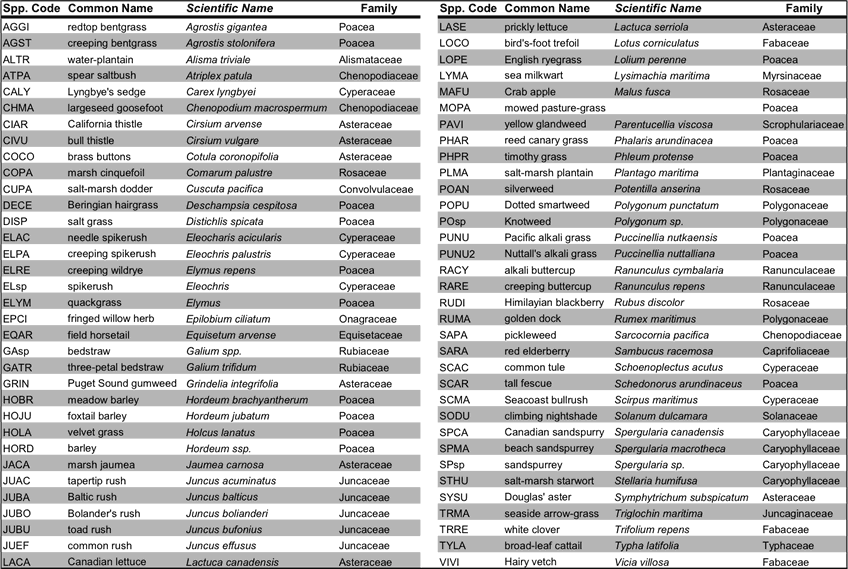
Spp. Code |
Common Name |
Scientific Name |
| AGST | Creeping bentgrass | Agrostis stolonifera |
| ATPA | Patent saltbush | Atriplex patens |
| BARE | Bare ground | |
| CHMA | Largeseed goosefoot | Chenopodium macrospermum |
| CIAR | California thistle | Cirsium arvense |
| CIVU | Bull thistle | Cirsium vulgare |
| COCO | Brass buttons | Cotula coronopifolia |
| DOM | Dead Organic Matter | |
| ELPA | Common spikerush | Eleochris palustris |
| ELRE | Quackgrass | Elymus repens |
| EPCI | Northern willow herb | Epilobium ciliatum |
| EQAR | Field horsetail | Equisetum arvense |
| GAssp | Bedstraw | Galium spp. |
| GATR | Threepetal bedstraw | Galium trifidum |
| HOLA | Velvet grass | Holcus lanatus |
| JUBA | Baltic rush | Juncus balticus |
| JUEF | Common rush | Juncus effusus |
| LI | Litter | |
| LOCO | Birdfoot trefoil | Lotus corniculatus |
| MAFU | Crab apple | Malus fusca |
| MOPA | Pasture Grass, mowed | |
| PHAR | Reed canary grass | Phalaris arundinacea |
| PHPR | Timothy grass | Phleum protense |
| POAN | Silverweed | Potentilla anserine |
| POPU | Dotted smartweed | Polygonum punctatum |
| RARE | Creeping buttercup | Ranunculus repens |
| RUDI | Himilayian blackberry | Rubus discolor |
| RUMA | Golden dock | Rumex maritimus |
| SARA | Red elderberry | Sambucus racemosa |
| SCMA | Seacoast bullrush | Scirpus maritimus |
| SODU | European bittersweet | Solanum dulcamara |
| TYLA | Broadleaf cattail | Typha latifolia |
| VIVI | Hairy vetch | Vicia villosa |
Other includes: AGRO, ATPA, CIVU ELEO, ELPA, ELRE, Galium, GRIN, JUEF, PHPR, RUDI, RUMA.
Note: the highest densities were from graminoids.
Spp. Code |
Common Name |
Scientific Name |
Average Height (cm) |
Average Density/m2 |
| AGST | Creeping bentgrass | Agrostis stolonifera | 52 | 1240 |
| ATPA | Patent saltbush | Atriplex patens | 44 | 40 |
| BARE | Bare ground | NA | NA | NA |
| CHMA | Largeseed goosefoot | Chenopodium macrospermum | 12 | 12 |
| CIAR | California thistle | Cirsium arvense | 62 | 6 |
| CIVU | Bull thistle | Cirsium vulgare | 34 | 4 |
| COCO | Brass buttons | Cotula coronopifolia | 24 | 228 |
| DOM | Dead Organic Matter | NA | 92 | 332 |
| ELPA | Common spikerush | Eleochris palustris | 84 | 68 |
| EPCI | Northern willow herb | Epilobium ciliatum | 30 | 12 |
| EQAR | Field horsetail | Equisetum arvense | 75 | 8 |
| GAssp | Bedstraw | Galium spp. | 34 | 840 |
| GATR | Threepetal bedstraw | Galium trifidum | 58 | 1100 |
| HOLA | Velvet grass | Holcus lanatus | 93 | 933 |
| JUBA | Baltic rush | Juncus balticus | 60 | 32 |
| JUEF | Common rush | Juncus effusus | 70 | 386 |
| LI | Litter | NA | 52 | NA |
| LOCO | Birdfoot trefoil | Lotus corniculatus | 67 | 153 |
| MAFU | Crab apple | Malus fusca | 13 | outside quad |
| MOPA | Pasture Grass, mowed | NA | NA | 800 |
| PHAR | Reed canary grass | Phalaris arundinacea | 118 | 384 |
| POAN | Silverweed | Potentilla anserine | 16 | 8 |
| POPU | Dotted smartweed | Polygonum punctatum | 28 | 68 |
| RARE | Creeping buttercup | Ranunculus repens | 27 | 7 |
| RUDI | Himilayian blackberry | Rubus discolor | 91 | 4 |
| SARA | Red elderberry | Sambucus racemosa | 235 | outside quad |
| SCMA | Seacoast bullrush | Scirpus maritimus | 129 | 44 |
| SODU | European bittersweet | Solanum dulcamara | 70 | 7 |
| TYLA | Broadleaf cattail | Typha latifolia | 124 | 18 |
| VIVI | Hairy vetch | Vicia villosa | 1 | outside quad |
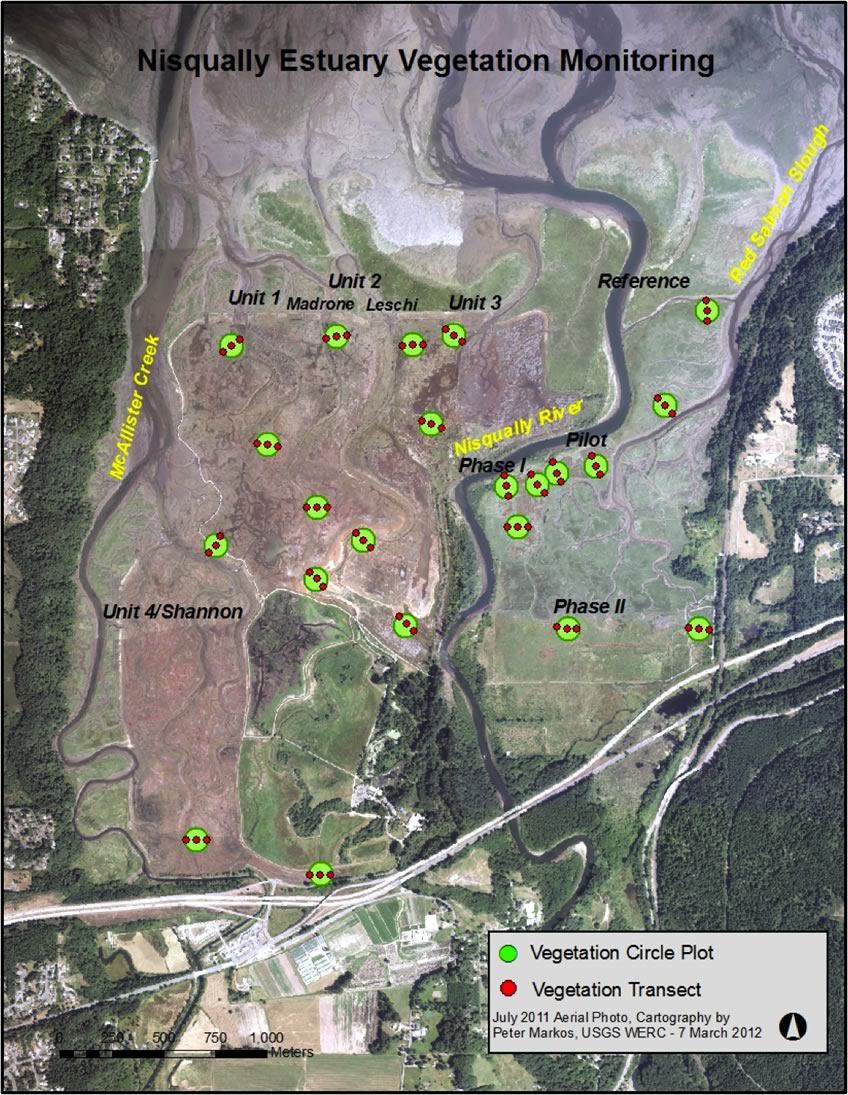
In conjunction with aerial photography, remote sensing, and bathymetry surveys of the bottom substrates, on-the-ground plant surveys will provide information on species composition and condition. Vegetation sampling will be conducted during summer when vegetative cover is at its maximum. Permanent, 40-m point-intercept transects (0.5 m intervals) will be established to determine the composition, height, and percent cover of plant species and to detect changes in vegetation through time. A 0.25 m2 grid will be examined at the beginning, middle, and end of each transect (3 quadrants per transect) to estimate mean stem density, height, and ocular estimates of percent cover of each species. The location of target plants or invasive species (such as reed canary grass Phalaris arundinaceae) will be tracked with GPS ground surveys or high precision aerial photographs. Data will be used to track changes of species extent, species richness, plant cover of natives and exotics, and vegetative condition (height and density).
In addition to transects and quadrants, aerial photography, and remote sensing for vegetation cover, at each visit we will identify invasive plants and record locations and species. During each vegetation survey, field surveyors will search for target invasive plants, record GPS location of invasive plant patches, and describe condition and extent of the patch (area, density, height). For larger patches of invasive plants, such as reed canary grass, we will delineate the extent of cover with a hand-held GPS or by remote sensing, and track changes to the extent of cover annually.