Science: Aerial Photography and Remote Sensing
Below are true color aerial photographs of the Nisqually Delta taken both before and after several tidal marsh restoration projects on the Nisqually Indian Tribe and Nisqually National Wildlife Refuge properties. The first photograph from 1997 was taken one year after dike removal on the Nisqually Indian Tribe Pilot site east of the Nisqually River. Two additional dike removal projects were completed on Tribal lands in 2002 (Phase I) and 2006 (Phase II). The most recent dike removal project was completed in Fall 2009 on the Nisqually National Wildlife Refuge, west of the Nisqually River. The final photographs focus on the mouth of Shannon Slough, one of the restored tidal channels on the Nisqually National Wildlife Refuge, pre and post dike removal.
Below: Aerial photos of the Nisqually Delta from 1997 to 2010
Mouse over images to pause animation
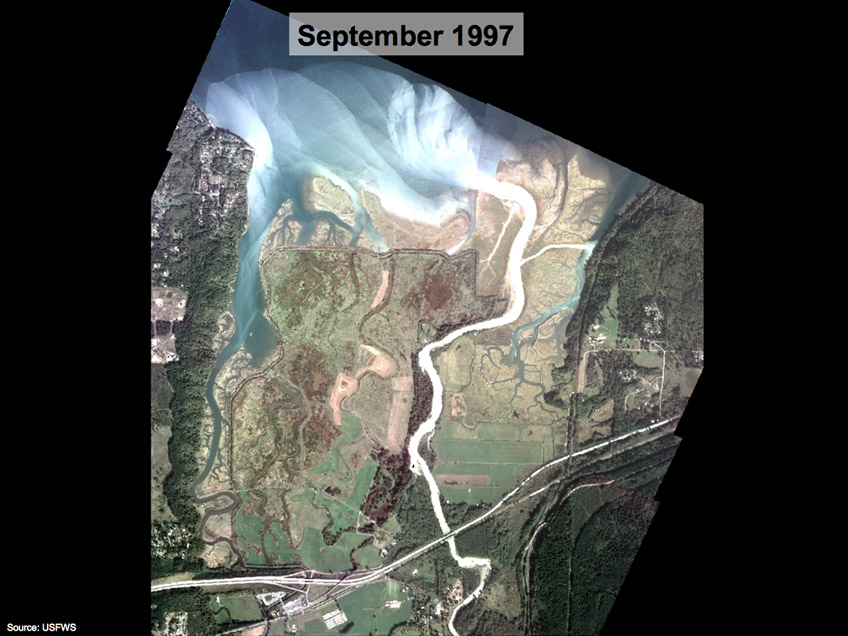
Aerial photographs shot at low tide when mudflats and channels are at maximum exposure are valuable tools for visual documentation of water drainage off the landscape and geomorphic change. We will take aerial photographs during the vegetative growing season. Color infrared (IR) aerial photographs will be georeferenced to UTM NAD 83 (ArcGIS, ESRI) using registered targets or landmarks. Color IR is better suited to distinguish vegetation signals from mud and bare ground than true color aerial photography. We will classify color infrared pixels into land cover classifications (such as water, mudflat, wetland vegetation, upland vegetation, and bare ground) using GIS (ERDAS Imagine Software, Leica Geosystems) and analyze the percent cover of each category. This remote sensing tool is valuable in tracking vegetation colonization over a large area over time. Vegetation colonization will be supplemented with on-the-ground vegetation surveys.